Abstraction Layers
When working with embedded Rust, you will often come across terms like PAC, HAL, and BSP. These are the different layers that help you interact with the hardware. Each layer offers a different balance between flexibility and ease of use.
Let's start from the highest level of abstraction down to the lowest.
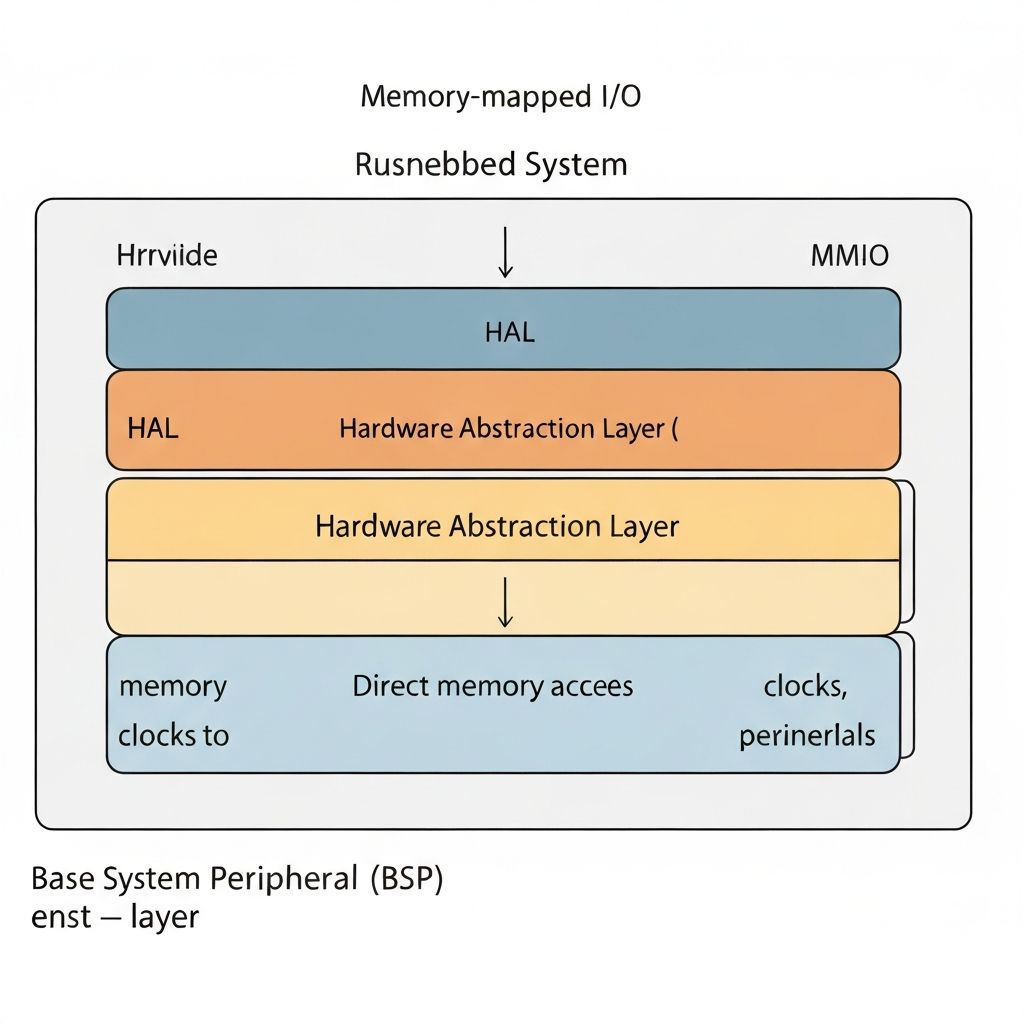
Embedded Rust Abstraction Layers
Board Support Package (BSP)
A BSP, also referred as Board Support Crate in Rust, tailored to specific development boards. It combines the HAL with board-specific configurations, providing ready to use interfaces for onboard components like LEDs, buttons, and sensors. This allows developers to focus on application logic instead of dealing with low-level hardware details.
Since there is no popular BSP specifically for the Raspberry Pi Pico 2, we will not be using this approach in this book.
Hardware Abstraction Layer (HAL)
The HAL sits just below the BSP level. If you work with boards like the Raspberry Pi Pico or ESP32 based boards, you'll mostly use the HAL level. HALs are typically written for the specific chip (like the RP2350 or ESP32) rather than for individual boards, which is why the same HAL can be used across different boards that share the same microcontroller.
For Raspberry Pi's family of microcontrollers, there's the rp-hal crate that provides this hardware abstraction.
What HAL Provides
- ▸Simpler, higher-level interfaces to the microcontroller's peripherals
- ▸Methods and traits for timers, serial communication, and GPIO control
- ▸Implementation of
embedded-haltraits - ▸Platform-independent interfaces for GPIO, SPI, I2C, and UART
Embassy for RP
Embassy sits at the same level as HAL but provides an additional runtime environment with async capabilities. Embassy (specifically embassy-rp for Raspberry Pi Pico) is built on top of the HAL layer and provides an async executor, timers, and additional abstractions that make it easier to write concurrent embedded applications.
Embassy provides a separate crate called embassy-rp specifically for Raspberry Pi microcontrollers (RP2040 and RP235x). This crate builds directly on top of the rp-pac (Raspberry Pi Peripheral Access Crate).
Throughout this book, we will use both rp-hal and embassy-rp for different exercises.
Peripheral Access Crate (PAC)
PACs are the lowest level of abstraction. They are auto-generated crates that provide type-safe access to a microcontroller's peripherals. These crates are typically generated from the manufacturer's SVD (System View Description) file using tools like svd2rust.
PACs give you a structured and safe way to interact directly with hardware registers.
Raw MMIO
Raw MMIO (memory-mapped IO) means directly working with hardware registers by reading and writing to specific memory addresses. This approach mirrors traditional C-style register manipulation and requires the use of unsafe blocks in Rust due to the potential risks involved.
We will not touch this area; I haven't seen anyone using this approach.